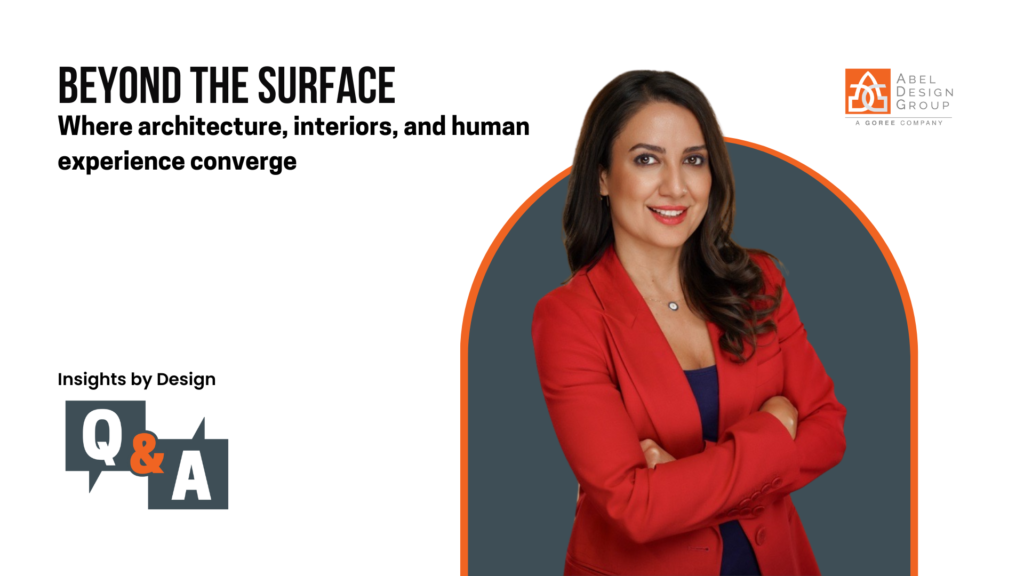
HOUSTON, TX, January 28, 2026 —
In this Insights by Design Q&A, Star Soltani reflects on how cross-disciplinary training informs her design philosophy, the invisible moments that define meaningful spaces, and how architects and designers are evolving to meet a future that demands flexibility, clarity, and experience-driven environments.
You are both a registered architect and interior designer, working across interior and exterior projects. How does that dual perspective influence the way you approach projects from concept through execution?
Star: Working in both disciplines allows me to approach design more holistically and three-dimensionally from the outset. The experience of a place begins well before you cross the threshold; it starts with approach, site context, entry, and the transition from outside to inside. When design is done well, the architecture and interiors feel like one continuous experience rather than two separate ideas.
That dual lens also changes how I evaluate scale. Architecture pushes you to consider orientation, light, and the building’s “big moves,” while interiors refine how a space feels once people begin to inhabit it over time. Together, they reinforce the same goal: a cohesive, intentional experience from start to finish.
You work across restaurants, corporate office interiors, and exterior/interior architecture. What principles stay consistent in your design approach regardless of project type?
Star: At its core, my approach is always human-centered. Regardless of typology, design begins with the people who will use the space, how they move through it, how they feel within it, and what the environment needs to support them.
What stays consistent is a focus on program, comfort, and behavior. Are we trying to encourage someone to pause and linger, or to move quickly and efficiently? Those questions guide every decision. While context may shift from city to city or client to client, the process always begins with understanding the end user and the intended purpose of the space.
Beyond the blueprint, many of the most impactful design decisions are subtle or unseen. What are some examples of behind-the-scenes decisions that significantly shape how a space functions and feels?
Star: Transitions are one of the most powerful yet understated design tools, moving from one space to another, from one material to the next, or between different lighting conditions. Those moments shape how a space feels emotionally, even if people can’t always articulate why.
Scale and proportion play a critical role as well. A more compressed entry followed by a more open volume can create a sense of anticipation or a memorable “wow” moment. Lighting helps establish hierarchy, shift mood, and guide attention. Together, these behind-the-scenes decisions make a space feel intuitive, comfortable, and intentional, even when they aren’t the first things someone notices.
Hospitality and workplace design are increasingly overlapping. How do you balance comfort, performance, and professionalism when those worlds intersect?
Star: Much of that balance comes down to sequence and contrast. You can create areas that feel more structured and focused, and then layer in softer, more hospitality-driven moments in the places meant for collaboration and community.
Materiality, furniture, and lighting do the heavy lifting. Warmer tones and layered lighting can bring comfort, while the overall environment still needs to support productivity and clarity. The goal is to create spaces that feel welcoming and at ease, without the environment becoming so casual that it loses its sense of purpose.
Restaurant projects often involve tight timelines, evolving concepts, and first-time operators. How do you help clients translate their vision into built environments without compromising functionality or long-term performance?
Star: It starts with relationship and communication. Our role is to bring a client’s vision to life while also guiding them through the realities they may not expect, especially if it’s their first build-out.
When timelines are compressed, we prioritize what matters most and protect the decisions that directly impact operations and long-term performance. We account for lead times early and steer material selections toward options that support the concept without jeopardizing the schedule. Throughout the process, the goal is to keep the process transparent, proactive, and solution-driven from day one.
How does your experience designing both interior and exterior architecture shape your approach to arrival, thresholds, and the transition between public and private space?
Star: Those moments are where experience truly takes shape. During programming, we closely examine adjacencies, hierarchy, and access; what is public-facing, employee-facing, or confidential, and how those zones relate to one another.
Then we decide how to express those transitions. In some cases, we highlight them to clearly signal a shift; in others, we soften or disguise them to create privacy or a sense of intrigue. Lighting, volume, material changes, and proportion all work together to orient the user and guide how they feel as they move through a space.
Many of your projects involve existing buildings. What excites you about adaptive reuse, and what challenges tend to emerge once a project moves beyond drawings and into construction?
Star: Adaptive reuse is exciting because it keeps you sharp, it’s inherently about discovery and problem-solving. While new construction offers a clean slate and predictability, existing buildings come with layers, surprises, and conditions you can’t fully know until construction starts.
That’s also where the creativity gets tested. When something unexpected shows up in the field, you have to quickly assess what can change, what must remain, and how those decisions impact cost, schedule, and intent. The challenge is pivoting without losing the intent of the design. It’s challenging, but when done well, it can be incredibly rewarding when the solution makes the project stronger than originally imagined.
Collaboration is critical to carrying design intent through construction. How do you work with consultants, contractors, and clients to maintain alignment when field conditions require adjustments?
Star: Respect and teamwork are everything. Even when contracts are separate, the mindset should be that everyone is working toward the same outcome, a successful project for the client.
When field conditions change, alignment comes from clear communication and shared problem-solving. We assess impact across disciplines, the cost implications, and the schedule realities, then work collaboratively to find the best path forward. Strong collaboration doesn’t start in the field; it is built early through trust, consistency, and treating every partner as an integral part of the team.
Material selection plays a major role in high-use environments like restaurants and offices. How do you evaluate durability, maintenance, and atmosphere when specifying materials?
Star: We start with how the space will actually function. High-traffic zones demand materials that can withstand wear, be maintained realistically, and still support the design intent.
We also help clients weigh first impressions against lifecycle performance. Some materials look compelling on day one but won’t hold up under daily use. That’s why we ask questions about cleaning routines, maintenance expectations, length of occupancy, and whether patina is acceptable or undesirable. The best selections strike a balance between experience and longevity, not just appearance.
Looking ahead, how do you see the role of architects and interior designers evolving as clients expect spaces to be more flexible, efficient, and experience-driven?
Star: Flexibility is quickly becoming nonnegotiable. The way people use space continues to evolve, and occupancy patterns are far less predictable than they once were. Designers are increasingly tasked with creating environments that can adapt operationally, culturally, and even from a brand perspective, without requiring a full rebuild.
As a result, the definition of success is shifting. It’s not only about how a space looks at opening, but how it performs over time, how it supports people, responds to change, and delivers an experience that feels intentional, relevant, and resilient.