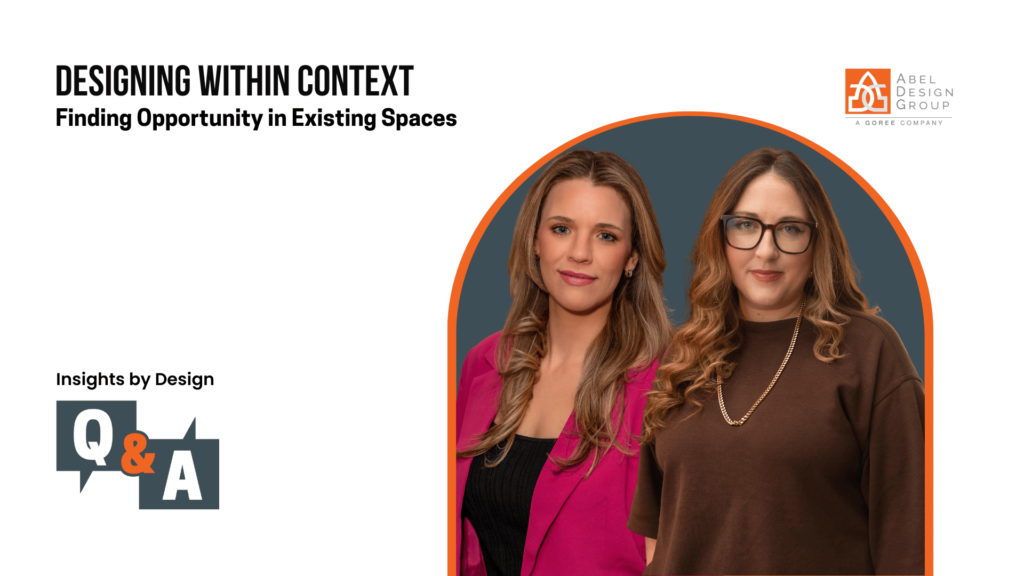
How Mallory Gaylor and Samantha Pendleton Find Opportunity in Existing Spaces
Every project begins with a set of existing conditions. Whether it’s a recently vacated office suite, a decades-old workplace, or a space filled with architectural features that a client isn’t sure they want to keep. At Abel Design Group, we work with existing conditions more often than not. Every project begins with understanding what already exists and identifying opportunities that others may overlook.
For Mallory Gaylor, Associate Principal, and Samantha Pendleton, Associate IV at Abel Design Group, designing within existing conditions is about more than adapting to constraints. It’s about recognizing potential, asking the right questions, and helping clients see possibilities they may not have considered. From evaluating infrastructure hidden above ceilings to preserving meaningful architectural elements, every decision is guided by a balance of client goals, budgets, functionality, and long-term value.
In this edition of Insights by Design, Mallory and Samantha discuss how experience has shaped their approach to design, why understanding existing conditions is one of the most important steps in the design process, and how thoughtful planning can transform limitations into opportunities.
Tell us about your role at Abel Design Group and the types of projects you focus on within your position, along with how interior designers typically work within existing conditions.
Mallory: As an Associate Principal at Abel Design Group, I focus primarily on corporate workplace projects, partnering with clients to transform existing office environments into spaces that better support their people, culture, and long-term goals. Because most of our work involves renovating existing spaces rather than starting from the ground up, every project begins with understanding what already exists.
Before we think about finishes or aesthetics, we work to understand the client’s vision, budget, and priorities while evaluating the building’s existing layout and infrastructure. Those early observations help us identify what should be preserved, what can be enhanced, and where thoughtful changes will create the greatest value.
Ultimately, our role is to find the right balance between respecting what already works and creating a space that feels fresh, functional, and aligned with the client’s goals.
Samantha: As a Project Manager and Lead Interior Designer, I also primarily work on corporate workplace projects, with a particular focus on law firms and other professional service organizations. A large part of our work involves helping clients transform existing office spaces rather than designing from the ground up.
One recent example is WCBG, where we became involved before the lease was signed. We toured several potential spaces with the client, helping evaluate which option would provide the greatest value while staying within budget. That early involvement allowed us to identify opportunities and help the client see each space’s potential before making a decision.
The space they selected featured extensive existing wood veneer. While some saw it as an asset and others wanted to remove it, our role was to demonstrate how those materials could be modernized rather than replaced. By carefully choosing what to preserve and what to update, we created a contemporary space while maximizing the client’s investment.
Looking back on your career, what experiences or lessons have had the greatest influence on the way you approach design today?
Samantha:Experience has been my greatest teacher. Every project presents new challenges, and the lessons that stay with you often come from the moments that don’t really go exactly as planned. Those experiences shape how you approach future projects and help you anticipate issues before they affect the client.
Mallory: Many of those lessons come from navigating unexpected challenges along the way. As you gain experience, you begin recognizing potential challenges before they become problems, and that’s something we work hard to pass along to our younger designers.
Mentorship is a big part of that process. We don’t just explain what to look for, we explain why it matters. Building codes, accessibility requirements, life safety, and construction coordination become second nature over time, allowing us to guide projects more confidently while helping others learn from those experiences.
How has your approach to evaluating existing spaces evolved throughout your career, and what do you think designers today are paying more attention to than they were a decade ago? How has that changed the way you balance budget, schedule, and design decisions?
Mallory: Today’s projects require designers to be more intentional than ever before. Rising construction costs mean clients expect us to accomplish more while making every dollar count, so understanding existing conditions has been increasingly important.
We’re paying closer attention to elements like mechanical systems, electrical infrastructure, plumbing, ceiling heights, and structural conditions because preserving those components can significantly impact both budget and schedule. The more information we gather upfront, the better equipped we are to make informed decisions that maximize value for the client.
Samantha: Clients also have access to more information than ever before. They come into meetings with ideas, inspiration, and expectations, which makes communication just as important as design itself.
Our role is to explore every possibility before recommending a path forward. We take the time to explain why certain decisions make sense from a design, budget, or construction standpoint. That transparency builds trust and helps clients feel more confident throughout the process.
What are some opportunities within existing environments that clients may not immediately recognize, but designers are trained to identify?
Mallory: One of the biggest opportunities is recognizing value in elements that clients may initially overlook. Existing architectural features, quality materials, and infrastructure often have tremendous potential when they’re thoughtfully incorporated into the design.
A great example is the Reyonds Frizzell project. The existing elevator lobby featured beautiful original travertine panels. While there was some hesitation about keeping them, we helped the client see how those materials could become an intentional part of the refreshed design. Preserving them allowed us to maintain the character of the space while creating a more modern workplace.
Samantha: Sometimes those opportunities are smaller but just as impactful. On Reynolds Frizzell, we were also able to preserve and update the existing reception desk rather than replacing it entirely. By refinishing and modifying what was already there, it became a seamless part of the new design.
Clients often focus on what they want to change. Our role is to help them recognize the value in what already exists and show how those elements can contribute to the overall vision.
Every project comes with constraints, whether related to budget, schedule, or program requirements. How do you balance those realities while still delivering a thoughtful design solution that reflects the client’s vision?
Mallory: It starts with understanding what’s most important to the client. Schedule, budget, and design priorities all influence the decisions we make, so having those conversations early allows us to establish realistic expectations and identify where flexibility exists.
Sometimes, preserving existing offices or infrastructure helps keep a project on schedule. Other times, material selections or product availability become the driving factors. Every project is different, so it’s about understanding the priorities and making informed decisions that best support the client’s goals.
Samantha: Communication plays a significant role in that process. We believe clients should understand not only what decisions are being made, but why they’re being made.
Ultimately, almost anything is possible with enough time and budget, but every project involves tradeoffs. By communicating openly throughout the process, we help clients make informed decisions that balance their priorities while still delivering a space they’re excited to move into.
Can you share an example of a project where an existing condition significantly influenced the final design outcome? How did your team respond to that opportunity or challenge?
Mallory: Stairs are often one of the biggest opportunities and challenges when we’re working within an existing building. Whether we preserve, relocate, extend, or completely redesign a stair depends on the building’s structural limitations, the client’s budget, and the overall goals for the space.
Projects like WCBG and Gray Reed Dallas that we are wrapping up illustrate how different every solution can be. At WCBG, we were able to preserve the existing stairs and update their finishes to better align with the refreshed workplace. At Gray Reed Dallas, however, the original plan was to refinish the exisitng stair before structural limitations required an entirely new solution.
Samantha: Those projects demonstrate why flexibility is so important. Existing conditions don’t always reveal themselves until design progresses or construction begins, so we’re constantly evaluating how to adapt while maintaining the integrity of the overall design.
Rather than viewing those moments as setbacks, we see them as opportunities to find solutions that best support the client’s goals, budget, and schedule.
How do factors such as circulation, visibility, natural light, views, and connectivity influence the way people experience a space, and how do those considerations shape your design decisions?
Mallory: Every existing space offers unique opportunities beyond its walls. Natural light, views, circulation, and the way people move through an environment all influence how a workplace functions and how employees experience it every day.
Views, in particular, often play a significant role in how we organize a floor plan. Clients may lease a space because of its connection to the surrounding city, whether that’s a downtown skyline, a park, or another defining feature. Our responsibility is balancing those opportunities with the practical requirements of the project, ensuring the overall layout supports both the client’s priorities and the functionality of the workplace.
Samantha: Those decisions are rarely as simple as placing an office in the corner with the best view. Every project involves balancing multiple priorities, including circulation, adjacencies, privacy, access to amenities, and the client’s operational needs.
Design is often about evaluating those competing factors and finding the solution that creates the best overall experience rather than optimizing for a single feature.
Visualizations, renderings, and other design tools often help communicate a project’s potential. How do these tools help clients better understand opportunities within an existing space?
Mallory: Most clients aren’t trained to visualize how an existing space can be transformed, and that’s where renderings become incredibly valuable. They help communicate the vision long before construction begins, allowing clients to see possibilities they may not have recognized when walking through the space.
Visualization tools also benefit us as designers. Seeing a space in three dimensions often reveals opportunities to refine details, adjust materials, or strengthen the overall design before anything is built.
Samantha: At the same time, it’s important to establish realistic expectations. Renderings represent the design intent, but projects naturally evolve as decisions are made throughout design and construction.
Ultimately, they’re a communication tool. They help clients understand the overall vision while giving our team another opportunity to evaluate the design. Sometimes it’s the smallest details that make the biggest difference, and when they’re done well, they’re often the things people never even notice.
That’s what creates a space that simply feels right.