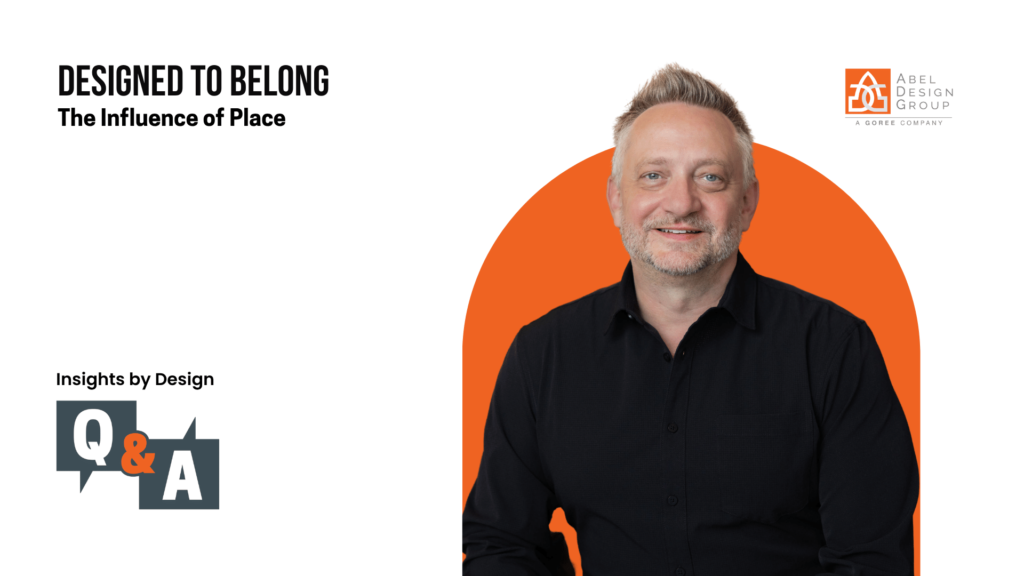
Bryan Kristof on Creating Spaces That Respond to Their Surroundings
The environment surrounding a space can be just as influential as what happens within it. From views and natural surroundings to neighborhood character, local culture, and walkability, context provides opportunities to create spaces that feel more connected to the places they belong.
In this edition of Insights by Design, Associate Principal Bryan Kristof shares how understanding the surrounding environment informs the design process, why local influences should feel authentic rather than expected, and how thoughtful connections to place can shape the way people experience a space.
Drawing from his work across workplace, hospitality, and civic environments, Bryan explores how designing within context can create spaces that not only function well, but simply feel good to be in.
Tell us about your role at Abel Design Group and the types of projects you focus on within your position as an Associate Principal. How has working across a variety of project types and locations influenced your approach to design?
Bryan: As Associate Principal and lead of Abel Design Group’s Denver office, my work has traditionally focused on workplace design, but we’ve also been growing our restaurant and hospitality portfolio. That variety has created a lot of crossover between project types and influenced how we think about the overall experience of a space.
Hospitality, in particular, continues to influence workplace design as companies look for ways to make the office more engaging and give people a reason to come in. It creates opportunities to incorporate more gathering spaces, amenities, and memorable design moments that support both the client and their culture.
Looking back on your career, what experiences or lessons have had the greatest influence on the way you approach design today?
Bryan: Early in my career, I worked on large-scale projects including airports, civic buildings, and courthouses. Those projects taught me the importance of coordination and strong construction documents. I’ve always viewed construction drawings as an art form because they’re ultimately what translate a design idea into the built environment.
We also thought of many of those projects as “100-year buildings,” which taught me to consider longevity and how people will experience a space over time. At the same time, every project has to relate back to the client.
Good design isn’t about forcing an idea into a space; it’s about understanding what the client needs and creating a solution that supports those goals.
Beyond the project itself, how does the surrounding environment influence the way design begins? What are some of the first contextual factors you evaluate before developing a design solution?
Bryan: In Denver, one of the first things we consider is the surrounding environment and the views available from a space. If there’s a great mountain view, for example, we look for ways to make it accessible to as many people as possible through shared spaces like conference rooms or break areas rather than limiting it to a private office.
We also look for authentic ways to connect a project to its location without becoming too literal. For a current project, we’re incorporating work from local artists. The artwork may not explicitly depict Denver, but it brings the creativity and diversity of the local community into the space in a meaningful way.
Can you share a project where the surrounding environment had a significant influence on the final design outcome? What opportunities or challenges did your team encounter?
Bryan: Duemani in Aspen is a great example. The restaurant’s open-air rooftop patio takes advantage of the surrounding mountain views, making the environment itself part of the dining experience.
Local character also comes through in smaller details, including custom leather wine bottle holders crafted by a local artisan for the private dining room. The material feels connected to
Aspen and the Colorado lifestyle, but in an elevated, contemporary way.
It’s a subtle example of how local influences can create a stronger connection between a space and its surroundings.
Projects are often shaped by factors beyond the designer’s control. How do local regulations, municipal requirements, client expectations, or project constraints influence the design process before creativity even begins?
Bryan: Code and life-safety requirements are some of the biggest factors shaping what we can do within a space. Occupancy calculations, exits, plumbing requirements, and the existing building infrastructure can all influence the size and quantity of spaces like conference rooms, break areas, and other gathering spaces. This can be especially challenging in older buildings that were designed under different codes.
It’s a technical side of design that clients may not always see, but it’s critical to the process. Our role is to understand those requirements early and find solutions that achieve the client’s goals while creating a space that is functional, safe, and code-compliant.
Over the past three to five years, how have you seen the Denver landscape evolve? What changes in the region have had the greatest influence on the way projects are designed and the needs of clients today?
Bryan: One of the biggest shifts has been the effort to give people a reason to return to the office. There’s been a greater emphasis on creating engaging environments that offer choice, flexibility, and experiences people can’t necessarily replicate at home.
The office has become less about simply providing a place to work and more about creating a place to gather. That shift has brought more hospitality-inspired elements into workplace design, with spaces focused on collaboration, connection, and making the overall experience of coming into the office more enjoyable.
How do connections to the surrounding environments, such as views, daylight, walkability, or the relationship between indoor and outdoor spaces, influence the experience people have within a space?
Bryan: People are increasingly drawn to spaces that give them choices and connections beyond the walls of their office. Some of Denver’s newer buildings have responded with shared amenity floors, outdoor terraces, gathering areas, and spaces where people can work while taking advantage of views and fresh air. Those amenities create a different experience and give people more reasons to want to be there.
The surrounding neighborhood matters, too. Cherry Creek is a great example because its walkability, restaurants, coffee shops, and activities create an environment people want to experience.
The success of a workplace isn’t only about what happens inside the building; the experience people have when they step outside can be just as influential.
As designers, why is it important to create spaces that respond to their surroundings rather than simply exist within them?
Bryan: I always say that “views are free.” If a project has an incredible view or another quality within its surroundings that can enhance the experience, we should take advantage of it. Those elements can have an enormous impact on how a space feels without necessarily adding to the project budget.
Ultimately, you want to create a space that feels good to be in. When a design responds thoughtfully to its surroundings and incorporates elements of the local culture and community, people may not consciously recognize every decision, but they feel the difference.
A well-designed environment should uplift people and create a place they’re excited to experience.